Grams are usually better than cups for baking when consistency matters. A gram is a unit of mass, so it measures the ingredient itself. A cup is a unit of volume, so its result depends on how the ingredient fills that space. Flour can be fluffy or compacted, brown sugar can be loosely filled or packed, and chopped ingredients can leave different air gaps.
Cups still have a practical place. They are familiar, quick for forgiving recipes, and available in kitchens without a scale. The useful question is not whether one system must disappear. It is which method gives the right balance of accuracy and convenience for the recipe in front of you.
Quick facts
- Most repeatable
- Grams reduce variation caused by scooping and packing.
- Most familiar in US kitchens
- Cups make common quantities easy to visualize.
- Key distinction
- Grams measure mass while cups measure volume.
- Conversion requirement
- A grams-to-cups conversion needs an ingredient-specific reference.
- Best rule
- Use the measurement system in which the recipe was developed whenever possible.
What grams measure
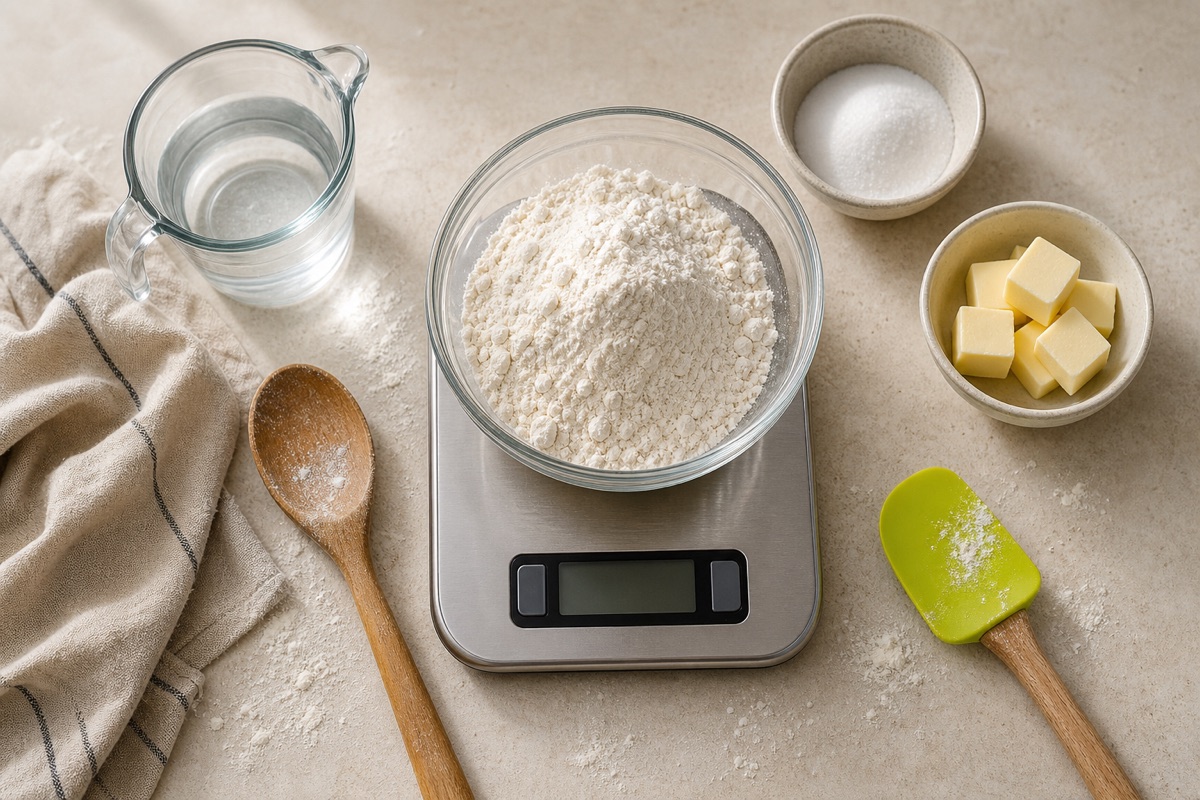
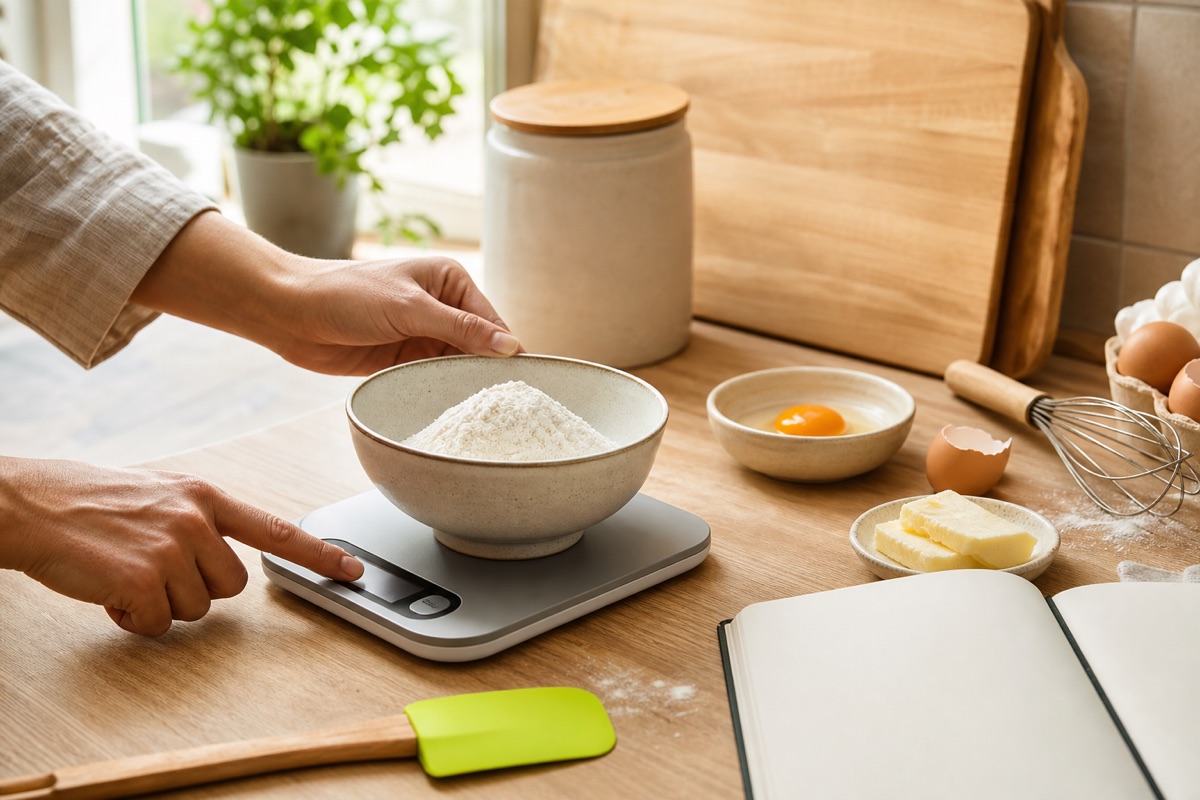
A scale measures mass and displays it as grams or another weight unit. If you weigh 200 grams of sugar today and 200 grams next week, the amount is the same even if you poured it into containers of different shapes.
Weight is easy to multiply, divide, and record. It is especially helpful for flour, sticky ingredients, bread formulas, large batches, and recipes where the ratio between components controls structure.
A digital kitchen scale for baking also allows ingredients to be measured into one bowl with the tare function, which can reduce prep time and dishes.
What cups measure
A cup measures volume. NIST lists one US customary cup as approximately 240 milliliters for kitchen equivalencies. A metric cup is 250 milliliters, so the word cup can refer to slightly different standards across regions.
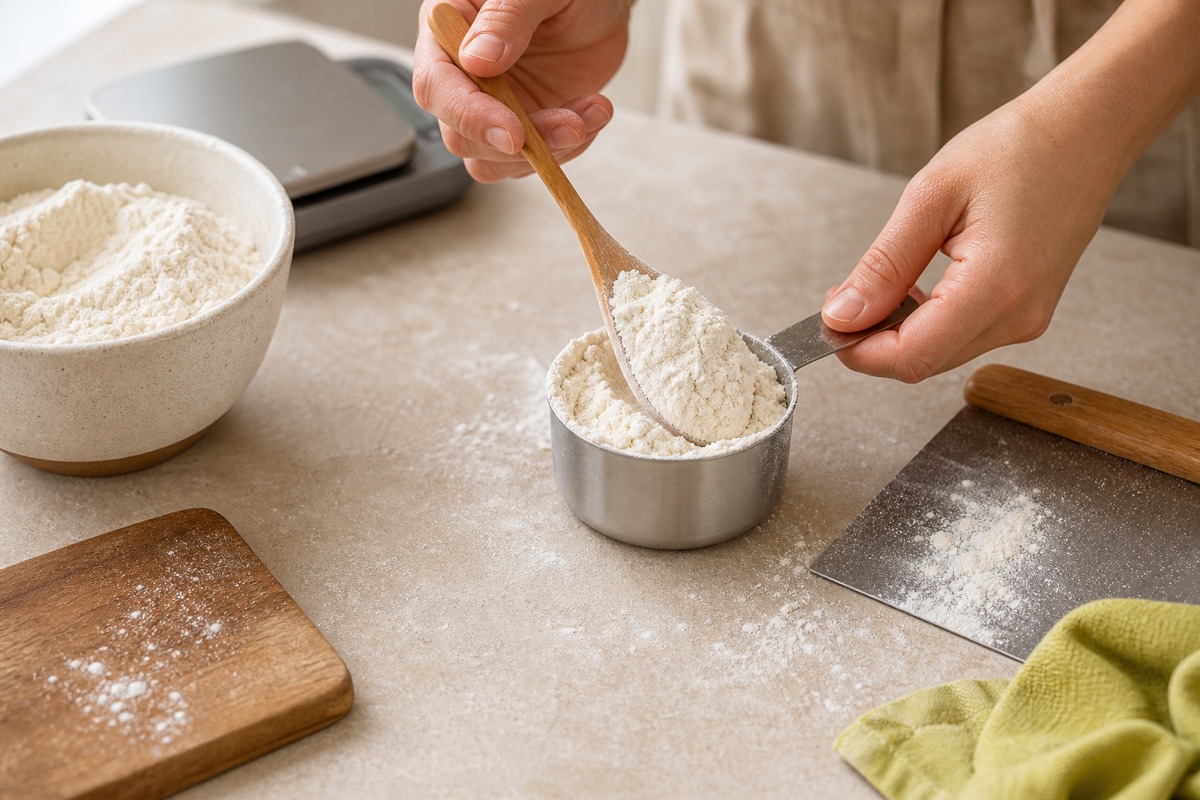
Volume works well for water-like liquids when you use a clear jug and read the line at eye level. Dry ingredients belong in rimmed dry measuring cups that can be filled and leveled. The physical tools are not interchangeable simply because both display cup units.
Cups become less repeatable when the ingredient traps air or changes shape. A cup of leafy herbs, chopped nuts, flour, or packed sugar depends heavily on preparation and filling technique.
Grams and cups compared
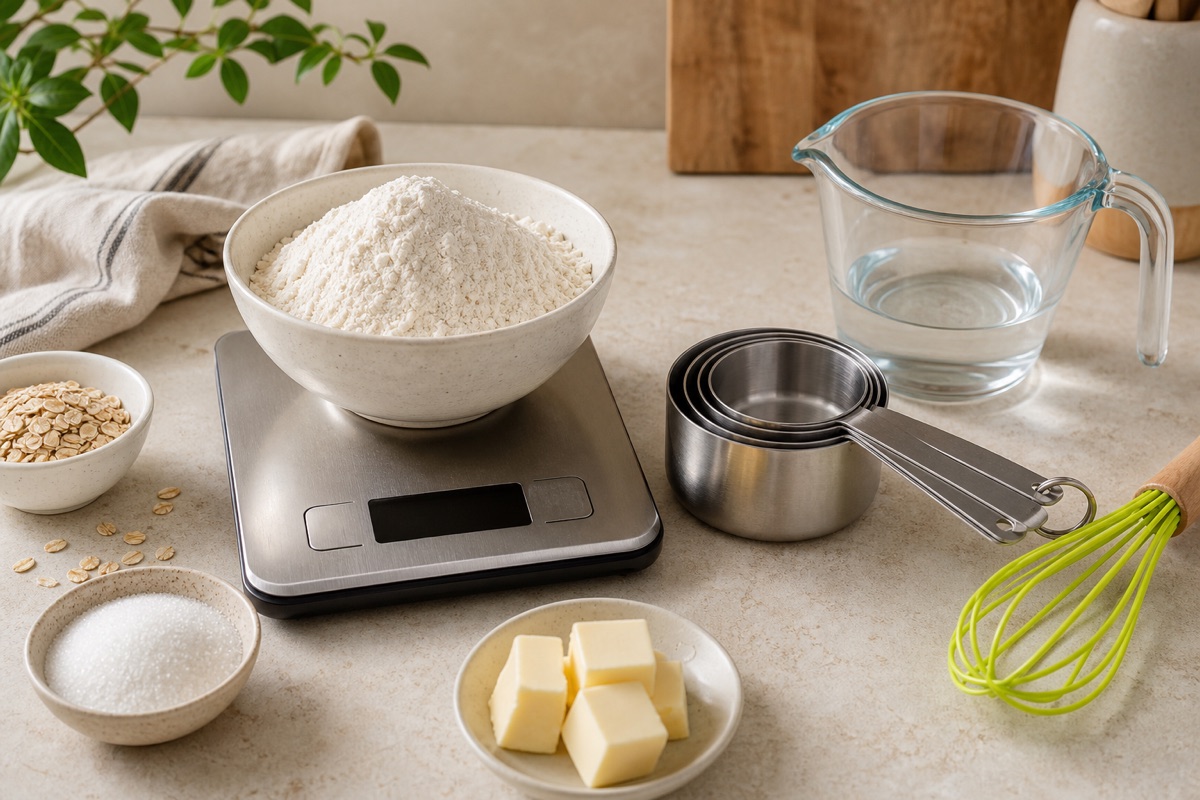
Grams win on repeatability and scaling. Cups win on familiarity and can be adequate for recipes with generous tolerances. Neither method compensates for an incorrect ingredient, a failed substitution, or an oven that runs hot.
The difference becomes most visible with flour. A scale stops at the target mass. A cup can hold more flour when it is dipped into the bag and less when the flour is aerated. That hidden variation may be larger than the small rounding differences in a conversion chart.
| Question | Grams | Cups |
|---|---|---|
| Repeatability | High | Depends on technique |
| Recipe scaling | Simple arithmetic | Fractions can become awkward |
| Equipment | Digital scale | Dry and liquid measures |
| Cleanup | Often one bowl | Several cups may be used |
| Visualization | Learned over time | Familiar to many US bakers |
| Ingredient density | No conversion needed | Required when converting from grams |
When to use grams and when cups are fine
Prefer grams for bread, pastry, macarons, cakes with delicate structure, candy, large batches, dietary calculations, and any recipe already written in weights. Weight is also the cleaner choice for honey, syrup, peanut butter, and shortening.
Cups can be perfectly practical for a forgiving family recipe, a quick sauce, a topping, or an occasion when no scale is available. Use the correct dry or liquid measure and follow packing or leveling instructions exactly.
If a trusted recipe lists both systems, choose one and follow it throughout. Mixing the gram amount for some ingredients with rounded cup equivalents for others can introduce several small differences into the same formula.
How to move between grams and cups
Start with the exact ingredient and preparation. Divide grams by that ingredient's grams-per-cup value to get cups. Multiply cups by grams per cup to move in the other direction. Keep full decimals until the end.
Use our ingredient-specific grams to cups converter for an instant result, or review the underlying values in the density chart. Both make the assumption visible instead of applying water's density to every food.
Treat the result as a practical estimate. Different respected recipe publishers may assign slightly different cup weights because they test with their own ingredients and methods. When possible, use the conversion associated with the original recipe.
Fact check
Common misconceptions
Professional recipes never use volume
Small spoons and liquid volumes still appear, but major ingredients are commonly weighed.
Cups are inaccurate in every situation
Careful volume measurement can be suitable for forgiving recipes and liquids.
A 240 ml cup means every cup weighs 240g
Milliliters are volume; gram weight changes with density.
Frequently asked questions
Are grams more accurate than cups?
Grams are generally more repeatable because they measure mass and do not depend on cup-filling technique.
Why do American recipes use cups?
Volume measures are familiar and widely available in US home kitchens.
Can I use a liquid cup for flour?
It is difficult to level flour accurately in a liquid cup. Use a rimmed dry measure.
Is a US cup the same as a metric cup?
No. A US customary cup is about 236.6 milliliters; a metric cup is 250 milliliters.
Should I convert a gram recipe into cups?
Only when necessary. If you have a scale, keep the original gram amounts.
The takeaway
Measure with a clear method
Grams are the stronger default for repeatable baking, easy scaling, and low-mess prep. Cups remain a useful household method when technique is consistent and the recipe is forgiving. Whichever you choose, preserve the recipe's original ratios and use ingredient-specific data for every conversion.
Open the grams to cups converter