A digital kitchen scale improves baking because it measures the ingredient itself rather than the space it occupies. Weight is repeatable: 120 grams of flour remains 120 grams whether the flour is settled, fluffy, or stored in a narrow container. That consistency protects recipe ratios and makes both successes and problems easier to reproduce.
A scale also shortens prep. Set a bowl on the platform, press tare, add an ingredient, reset to zero, and add the next one. You can avoid several measuring cups, scrape less sticky honey or peanut butter from utensils, and scale a recipe with straightforward multiplication.
Quick facts
- Primary benefit
- Weight removes variation caused by packing and cup-filling technique.
- Essential control
- The tare button subtracts the bowl and resets between ingredients.
- Useful resolution
- One-gram increments suit most home baking; finer resolution helps with tiny quantities.
- Practical capacity
- A capacity of at least 5 kilograms covers most mixing bowls and home batches.
- Safer workflow
- Keep the display visible and avoid exceeding the scale's stated maximum load.
A scale makes recipes more consistent
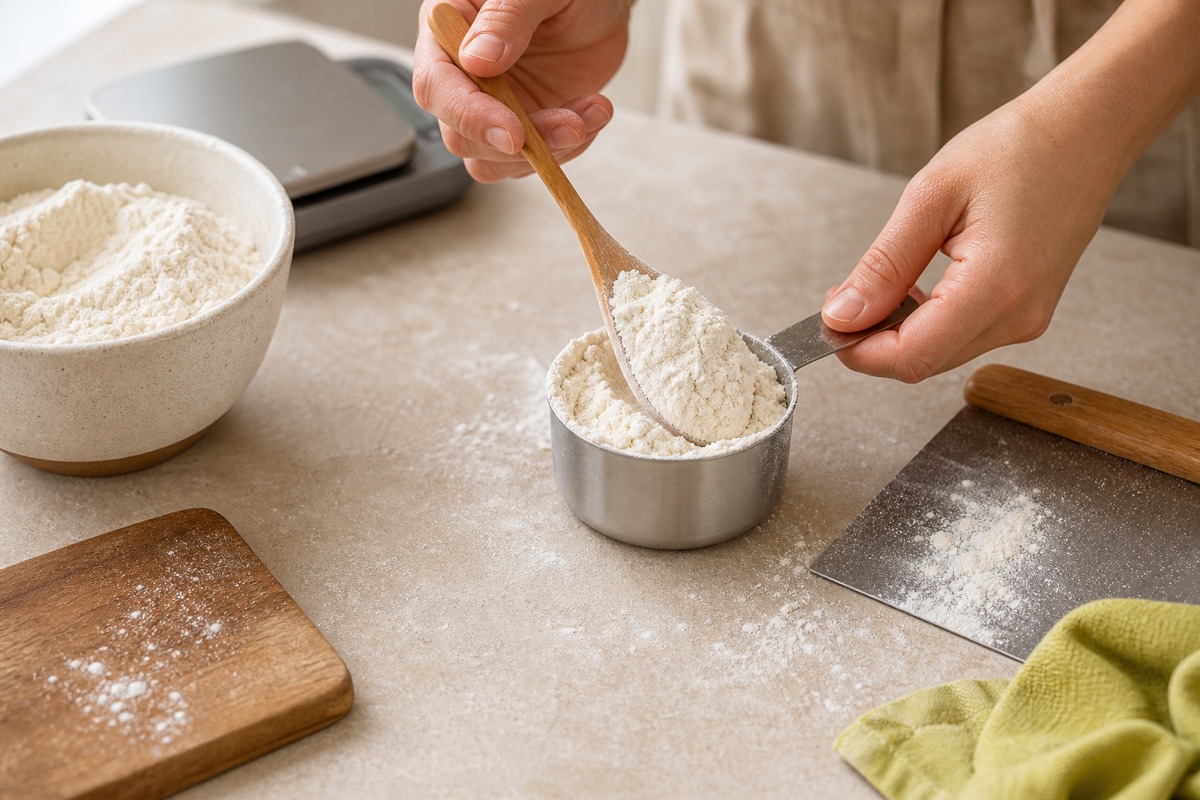
Volume measurement depends on technique. A cup of flour becomes heavier when it is scooped, shaken, or packed. Chopped nuts fit differently depending on piece size. Brown sugar changes with packing pressure. Weight measures the amount after all those air gaps and shapes stop mattering.
That does not make a scale perfect. The recipe's target weight still needs to be sound, the scale must sit on a stable surface, and ingredient substitutions can change behavior. It does remove a major variable from your own process.
When you receive a recipe in grams but need a volume reference, use the grams to cups converter. For the bake itself, keep the grams whenever you have a working scale.
It is faster and creates fewer dishes
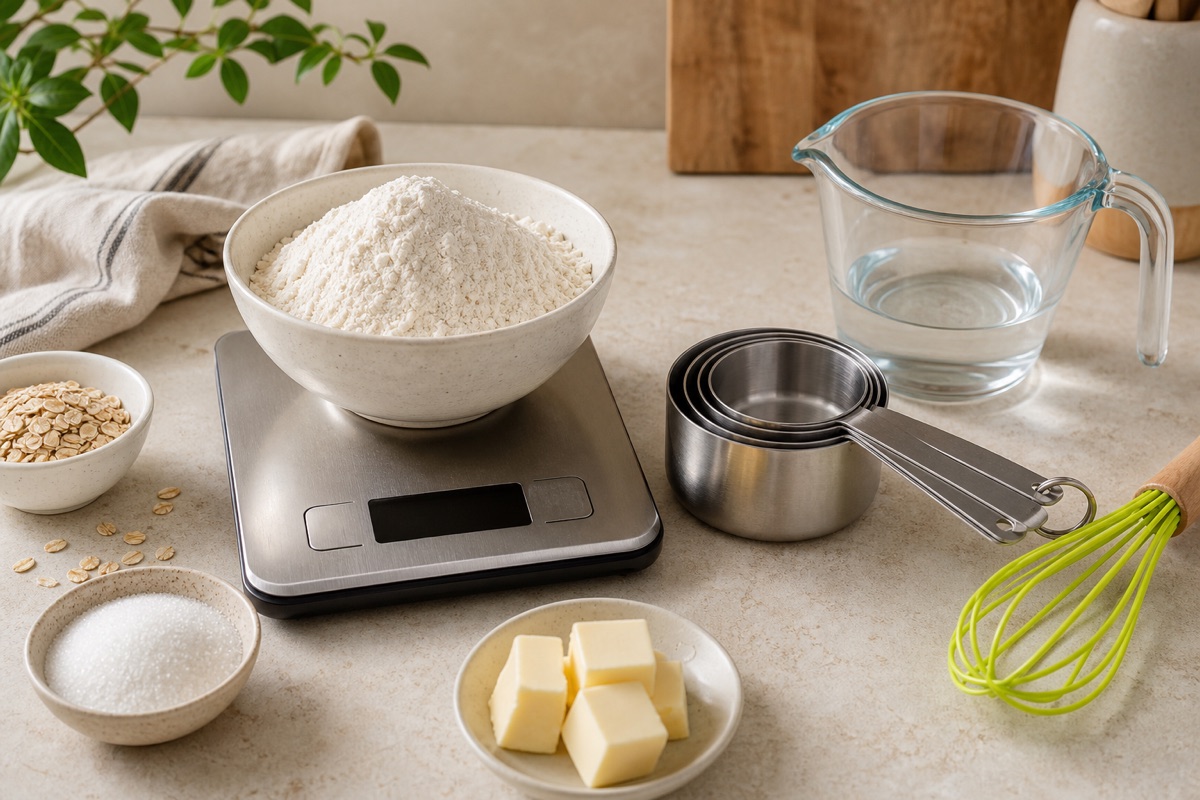
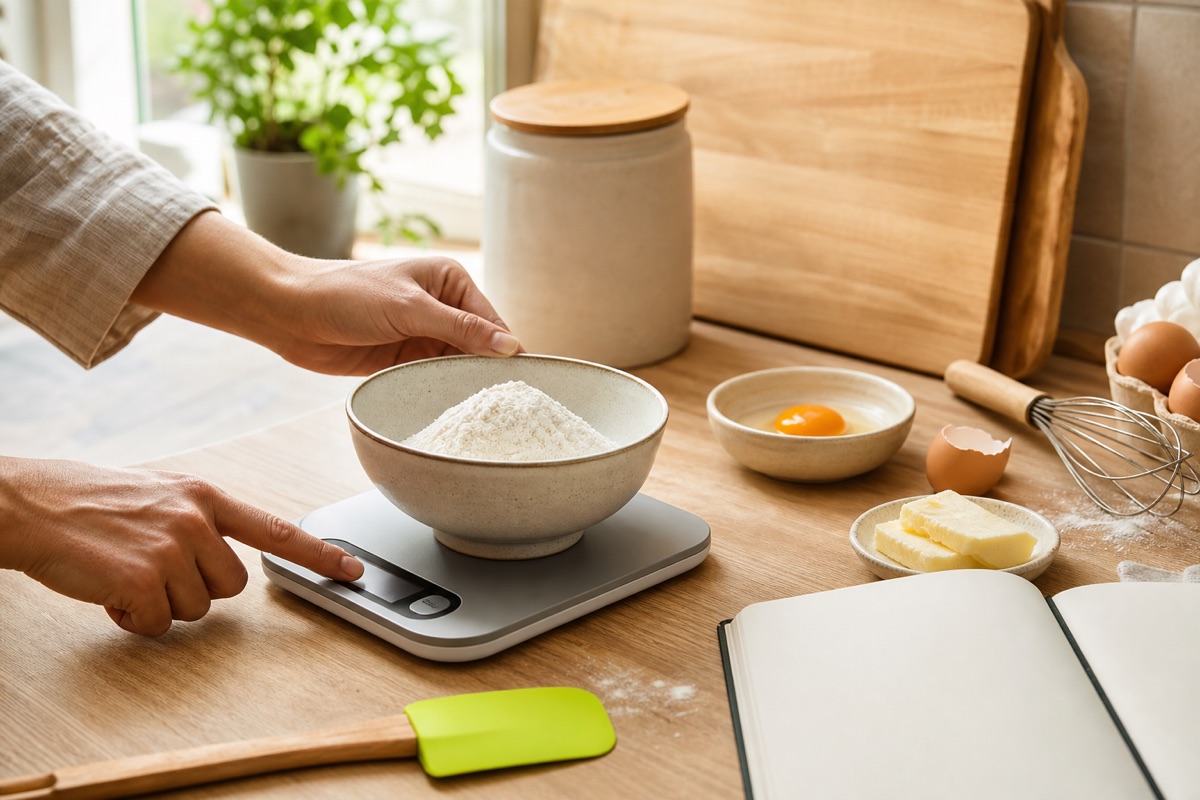
Place the mixing bowl on the scale and weigh dry ingredients directly into it. Press tare between additions so the display returns to zero. This one-bowl method eliminates repeated filling, leveling, and washing of cup measures.
The advantage is especially clear with sticky ingredients. Instead of coating a cup with honey, syrup, nut butter, or shortening and then scraping it out, you can add the exact weight directly to the bowl. Less remains on a utensil and the counter stays cleaner.
For ingredients that must remain separate, use small prep bowls and weigh each one. Speed should not override the recipe method. If eggs, leavening, or a liquid must be combined later, keep them separate until the correct step.
Weight makes recipe scaling simpler
Doubling 175 grams gives 350 grams. Halving 350 grams gives 175 grams. The same change written as cups may require multiplying mixed fractions, then converting a remainder into tablespoons and teaspoons.
For a full workflow, read how to scale a recipe up or down. Weight solves the arithmetic, while that guide also covers eggs, leavening, pan size, and baking time.
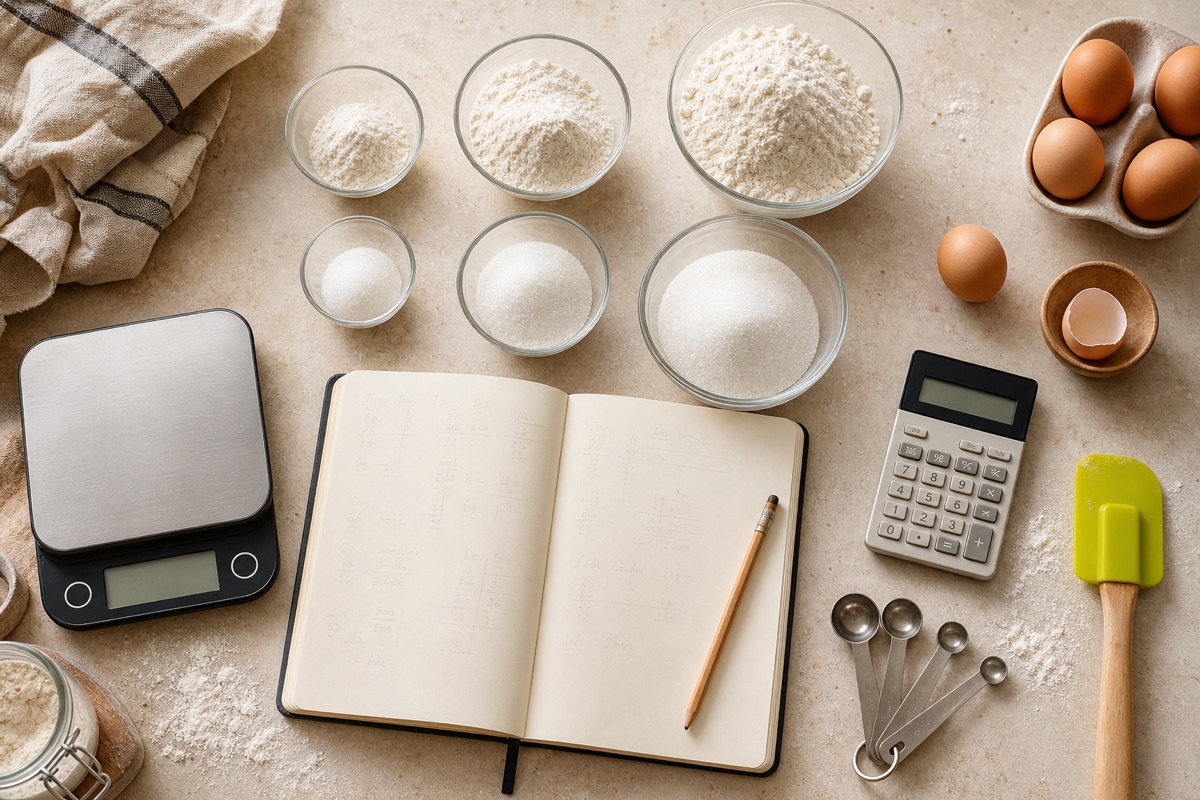
Bread formulas become particularly transparent in grams because ingredient percentages can be calculated relative to flour weight. That makes it possible to choose a desired dough size while preserving the ratio of water, salt, yeast, and flour.
What to look for in a baking scale
Choose a scale with a platform wide enough for your usual bowl without hiding the display. A capacity around 5 kilograms is practical for home baking, and one-gram resolution is suitable for most flour, sugar, liquid, and fat measurements.
Check that the tare control is easy to reach with a bowl in place. A bright display, quick response, auto-off behavior that is not too aggressive, and common batteries or simple charging all improve daily use. A removable or wipeable platform helps with cleanup.
For yeast, salt, spices, or other very small amounts, a one-gram scale may move in jumps that are too coarse. Use measuring spoons when the recipe is designed for them or a separate precision scale that is rated for small quantities.
| Feature | Practical target | Why it matters |
|---|---|---|
| Resolution | 1 gram | Suitable for most home-baking ingredients |
| Capacity | 5 kilograms or more | Supports a bowl plus a normal batch |
| Tare | Dedicated button | Resets between bowl and ingredients |
| Display | Visible with bowl | Prevents awkward reading and overshooting |
| Units | Grams and ounces | Matches metric and US weight recipes |
How to use a kitchen scale correctly
Use a hard, level counter
Soft surfaces can interfere with the load sensors and create unstable readings.
Turn on the scale before loading it
Allow it to display zero and choose grams.
Place the empty bowl and press tare
Confirm that the bowl is not included in the ingredient weight.
Add ingredients gradually
Slow down near the target so you do not overshoot.
Tare between ingredients
Reset only when the recipe allows the next ingredient to go into the same bowl.
Clean without flooding
Wipe the platform according to the manufacturer's instructions and keep liquid away from controls and seams.
If the display drifts, check the surface, battery, bowl position, and anything touching the bowl. A utensil resting partly on the counter can carry some weight off the platform and produce a misleading result.
Fact check
Common misconceptions
Scales are only for professional bakers
Basic weighing improves ordinary cookies, cakes, breads, and meal prep at home.
Volume is always faster
Taring ingredients into one bowl often saves both measuring and cleanup time.
A scale fixes every recipe
It improves measurement consistency but cannot correct a poor formula, substitution, or oven problem.
Frequently asked questions
Do I need a kitchen scale for baking?
No, but a scale usually improves consistency and makes gram-based recipes easier to follow.
What does tare do?
It subtracts the current load and resets the display to zero.
Is one-gram accuracy enough?
Yes for most home-baking ingredients. Very small amounts may need spoons or a finer scale.
Can I weigh liquids in grams?
Yes when the recipe provides a gram weight. Do not assume every milliliter weighs one gram.
Why does my scale reading change?
Check for an uneven surface, low battery, off-center bowl, drafts, or an object touching the bowl.
The takeaway
Measure with a clear method
A digital kitchen scale is valuable because it removes avoidable measuring variation while making prep faster and cleaner. Learn the tare button, keep the scale on a stable counter, and use the recipe's gram amounts directly. The payoff is a process you can repeat with confidence.
Open the grams to cups converter