To convert grams to cups accurately, first identify the ingredient, find how many grams of it fit into one US cup, and divide the recipe weight by that value. There is no single grams-to-cups number because grams measure weight while cups measure volume. A cup of flour is much lighter than a cup of sugar, and a cup of honey is heavier than both.
For a fast answer, select the exact ingredient in our grams to cups converter. It applies the correct grams-per-cup reference and returns both a practical fraction and a decimal result. The method below explains the same calculation so you can check a result or convert a recipe by hand.
Quick facts
- Core formula
- Cups = grams divided by grams per cup.
- Cup standard
- This site uses a US customary cup, approximately 240 milliliters for kitchen use.
- Ingredient rule
- Always use the density for the named ingredient and preparation.
- Flour example
- Using 120 grams per cup, 240 grams of all-purpose flour equals 2 cups.
- Best accuracy
- Use the gram amount from the original recipe whenever a kitchen scale is available.
Why the ingredient changes the answer
A gram tells you how heavy something is. A cup tells you how much space it occupies. Those measurements only connect when you know the ingredient's typical weight for that volume. Fine, compact ingredients place more mass into a cup than light or irregular ingredients.
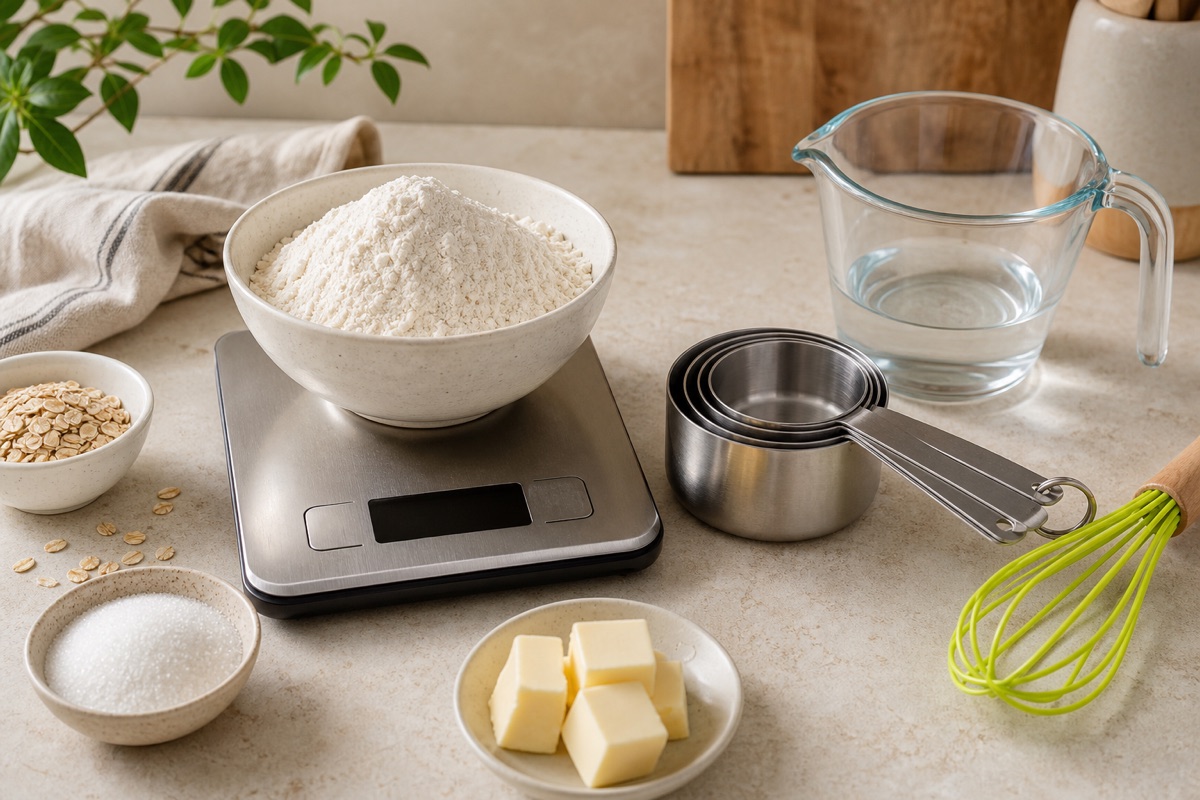
All-purpose flour is commonly referenced at about 120 grams per cup when it is gently filled and leveled. Granulated sugar is close to 200 grams per cup, butter is about 227 grams per cup, and honey may be around 340 grams per cup. That means 200 grams can represent about 1.67 cups of flour, 1 cup of sugar, 0.88 cup of butter, or 0.59 cup of honey.
You can compare the working values used throughout this site in the ingredient density chart. Preparation labels such as packed, sifted, chopped, melted, or whole are part of the ingredient definition, not optional details.
The grams to cups formula
Use this equation: cups = grams ÷ grams per cup. If a recipe lists 300 grams of all-purpose flour and your reference is 120 grams per cup, divide 300 by 120. The answer is 2.5 cups. For 150 grams of granulated sugar at 200 grams per cup, the answer is 0.75 cup.
Keep the decimal until the calculation is complete. Then translate it into a useful kitchen fraction. A decimal of 0.25 is one quarter cup, 0.5 is one half, and 0.75 is three quarters. Values such as 0.42 or 1.67 do not fit a simple cup fraction perfectly, so use tablespoons for the remainder or keep the gram measurement.
Do not insert milliliters into this ingredient formula. Milliliters describe volume and are useful for liquid capacity, but they do not reveal what a dry ingredient weighs. The grams-per-cup value already connects the ingredient's weight to one cup of volume.
| Ingredient | Weight | Reference | Result |
|---|---|---|---|
| All-purpose flour | 240g | 120g per cup | 2 cups |
| Granulated sugar | 150g | 200g per cup | ¾ cup |
| Butter | 113.5g | 227g per cup | ½ cup |
| Honey | 170g | 340g per cup | ½ cup |
How to convert grams to cups step by step
Name the ingredient precisely
Choose all-purpose flour rather than just flour, packed brown sugar rather than sugar, or rolled oats rather than oats. Small wording differences can point to different cup weights.
Confirm the cup standard
Use the US customary cup when following American recipes. Metric cups are often 250 milliliters, so mixing standards can create a small but avoidable difference.
Find the grams-per-cup value
Use a trusted ingredient chart, recipe-author reference, or the value shown beside the ingredient in the converter.
Divide and keep the decimal
Divide the recipe's grams by grams per cup. Retain several decimal places until the final step so early rounding does not compound.
Choose a practical finish
Use a familiar cup fraction when the result is close. For awkward remainders, use tablespoons or return to a scale for a cleaner measurement.
The original recipe should win when it provides both grams and cups. Recipe authors may test with a particular brand, measuring method, or house standard. Use its gram amount for precision and treat a general chart as a practical substitute when you only have cups.
Common baking conversions to remember
A small reference set can handle many everyday bakes. One cup of all-purpose flour is commonly treated as 120 grams, granulated sugar as about 200 grams, packed brown sugar as roughly 213 to 220 grams, and butter as 227 grams. These are useful working values, not universal physical constants.
For more weights and fractions, open the grams to cups conversion chart. It keeps each ingredient in its own table so a flour value cannot be mistaken for a sugar value.
Brand, moisture, particle size, settling, and the way a cup is filled all influence the final weight. Flour is particularly sensitive to scooping. If a converted batter looks much drier or wetter than expected, verify the ingredient type and reference value before adding extra liquid or flour.
When you should keep the recipe in grams
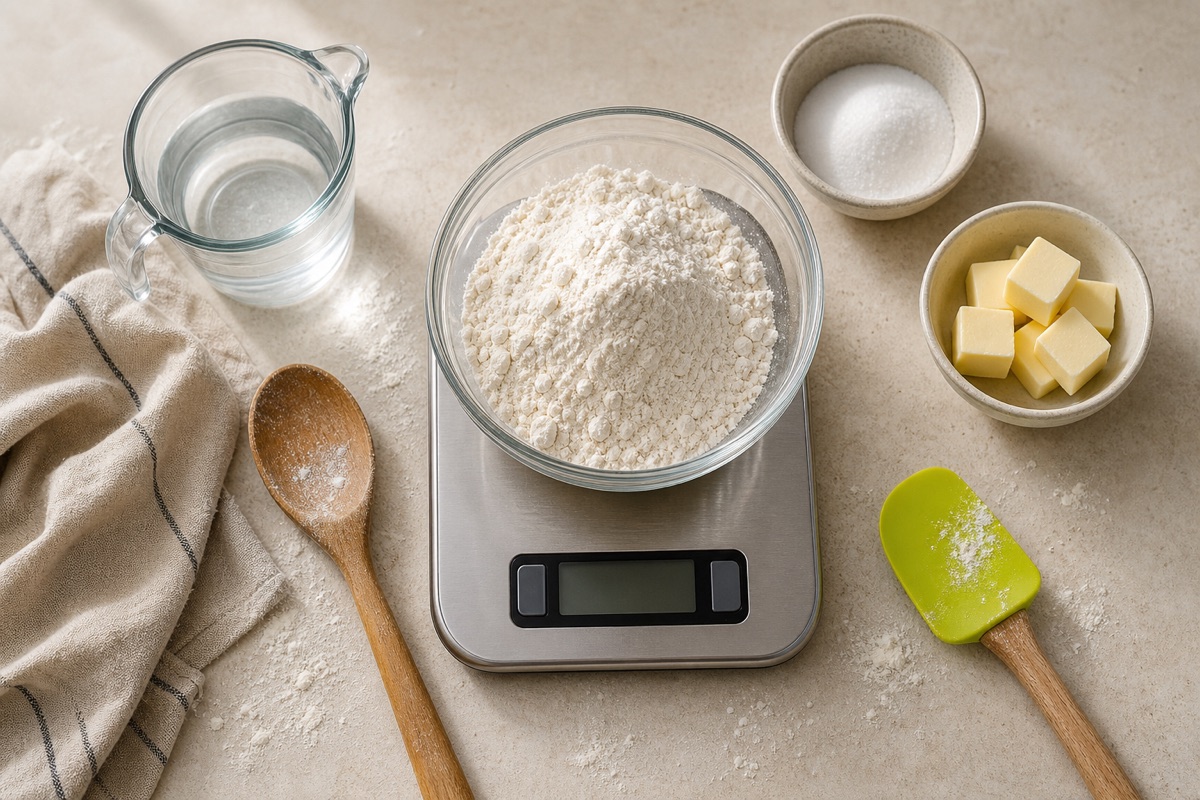
Keep gram measurements for bread formulas, macarons, pastry, candy, large batches, and recipes where a small ratio change can alter structure. A digital scale also makes sticky ingredients easier because you can weigh them directly into the mixing bowl instead of scraping a measuring cup clean.
Cup conversions are most helpful when a scale is unavailable, a familiar volume helps you visualize an amount, or you are adapting a recipe for someone who only owns cup measures. They are a convenience layer. They do not improve on the original weight measurement.
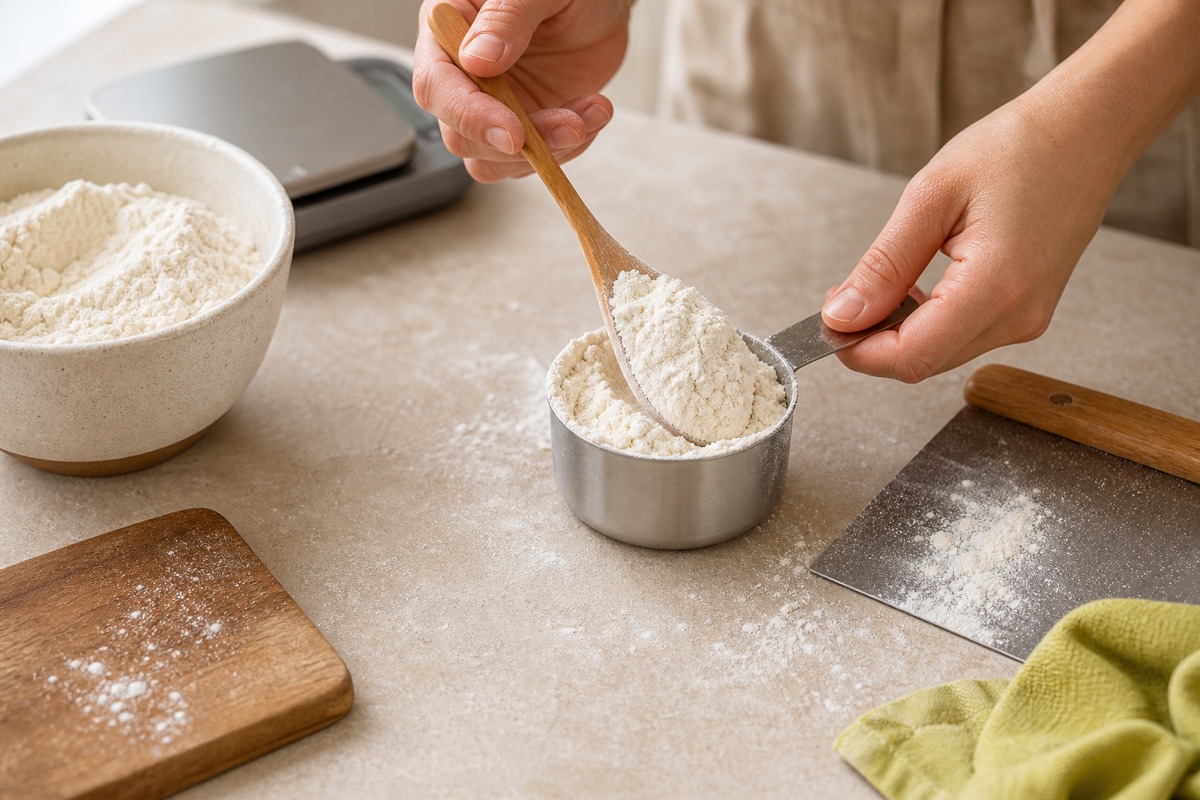
If you use cups, fill dry measures without shaking or tapping unless the recipe tells you to pack the ingredient. Read liquids at eye level in a clear liquid measure. Consistent technique will usually matter more than chasing another decimal place.
Fact check
Common misconceptions
One cup always weighs 240 grams
A cup is volume. Only ingredients with a cup weight near 240 grams will produce that result.
Water can stand in for every ingredient
Water-based shortcuts fail for flour, sugar, fats, grains, and syrups because their densities differ.
More decimal places mean more accuracy
A precise-looking calculation cannot remove variation caused by scooping, packing, brand, or moisture.
Frequently asked questions
How many cups is 100 grams?
It depends on the ingredient. It is about 0.83 cup of all-purpose flour, 0.5 cup of granulated sugar, or 0.44 cup of butter using this site's references.
Is one cup 240 grams or 240 milliliters?
A kitchen cup is approximately 240 milliliters of volume. Its weight in grams changes with the ingredient.
Can I convert grams to cups without an ingredient?
Not reliably. You need an ingredient-specific grams-per-cup value.
Should I round to the nearest quarter cup?
Only when the recipe is forgiving and the result is genuinely close. Use tablespoons or grams for awkward values.
Are US and metric cups the same?
No. A US customary cup is about 236.6 milliliters, while a metric cup is 250 milliliters.
The takeaway
Measure with a clear method
The dependable method is simple: identify the ingredient, use its grams-per-cup reference, divide, and round only at the end. A cup conversion is most useful as a practical backup; the original gram measurement remains the best route to repeatable baking.
Open the grams to cups converter